
If you might sell your business in 2027, your partner program is either an asset a buyer can underwrite or a line item they have to take on faith. Most owners never find out which until diligence, and by then it is too late to fix.
Partner revenue is attractive to a buyer for a simple reason: it is a way of acquiring customers that does not depend entirely on the founder or on paid ads. It is also easy to doubt. A buyer who cannot tell where the revenue comes from, who owns the relationships, or whether the partnerships survive a change of owner will usually discount it, or ignore it.
What buyers are paying for right now. Flippa's H1 2026 insights report covers the online business market from January 1 to June 30, 2026. Its short answer to what buyers reward is recurring revenue, low owner dependency, and documented, clean operations.
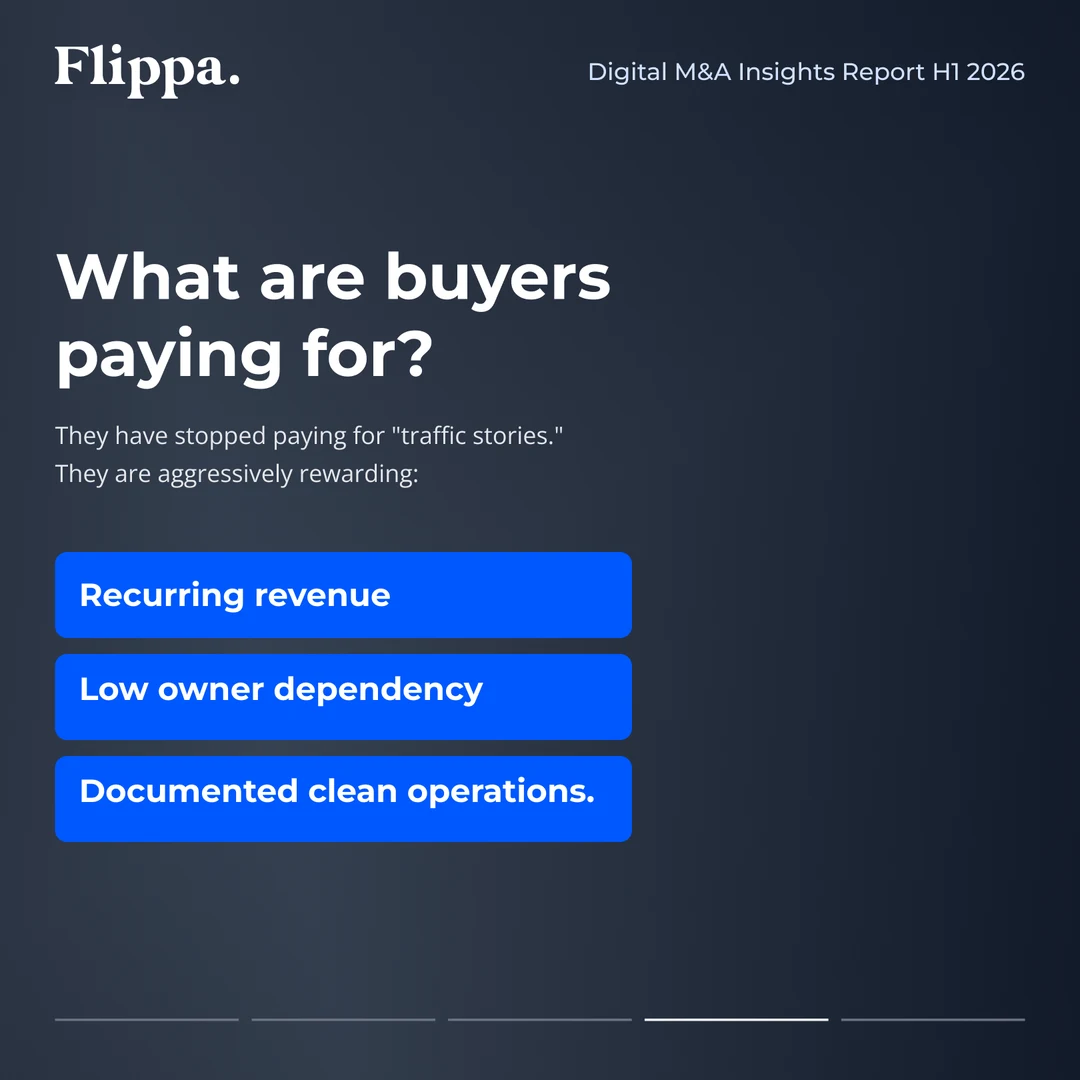
Source: Flippa, Digital M&A Insights Report H1 2026.
Flippa's data does not break out partnerships as a factor, so what follows is our reasoning from working with partner programs, not something the report proves. But the fit is easy to see. Partner revenue can be recurring, it can run without the founder in the room, and it can be documented. The sellers who get paid more are the ones who can show their work.
The same report shows how much that can matter. In each of the three deal sizes it charts, top-quartile sales went at a higher multiple than the average, from 2.84x against 1.82x for deals between $250,000 and $1 million, to 5.42x against 2.50x for deals over $1 million.

Source: Flippa, Digital M&A Insights Report H1 2026.
The questions a buyer will ask about partner revenue
- How much of your revenue comes from partners, and how much of that is one partner? Concentration is the first thing a careful buyer checks. One partner behind 40% of partner revenue is a risk, not a channel.
- Is any of it under contract, and what do the contracts say? Look for termination terms, exclusivity, and especially whether the agreement can be assigned to a new owner or ends on a change of control. Have a lawyer read these before a buyer does.
- Does the relationship live in your head? If you are the only person the partner talks to, the buyer is buying you, not the channel.
- Is the revenue sourced or influenced? Partner-sourced means the partner brought the customer. Partner-influenced means they were involved somewhere in the deal. Mixing the two inflates the number and buyers notice.
- What is the headroom? Today's partner revenue is what you have. A buyer pays more when they can see how it grows: partners signed but not yet ramped, a repeatable way you recruit them, and a way you train them.
The partner section of your data room
Build this a year before you list, not a month. At minimum:
- A table of revenue by partner for the last 24 months, split into sourced and influenced, with each partner's share of the total.
- The contract for every partner, with termination and assignment terms pulled into a one-line summary.
- A named owner for every relationship on your team, and a note on who would cover it if that person left.
- A short description of how a partner goes from signed to producing revenue, and how long that usually takes.
- Your pipeline: partners in conversation, partners signed but not ramped.
Two items on that list carry the most weight, because they answer questions a buyer cannot check on their own: how much room is left to grow, and whether the knowledge is written down. We built RevRadius, our own partner-scoring tool, to record exactly that. Each partner gets a Today score and a Potential score, kept separate, with the reasoning written beside every dimension. Across a roster, it shows which partners are already worth the most and which have the most room left. The gap between Today and Potential is the headroom a buyer can underwrite, and the notes are the record that keeps a relationship from living in one person's head.
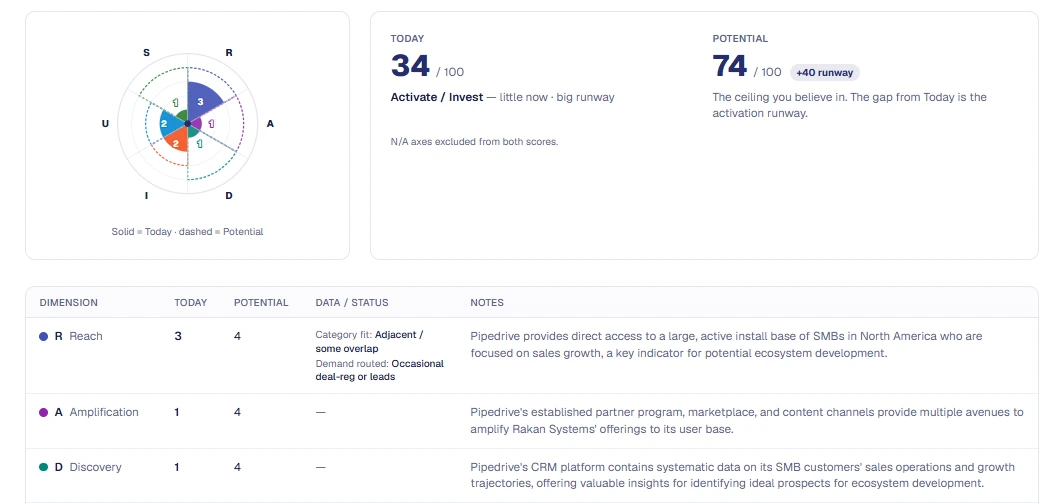
A partner scored in RevRadius, our own tool: Today and Potential as separate numbers, with the reasoning behind each dimension.
If you cannot fill in the first row of that table today, that is the finding. Fixing it is cheap now and expensive in the middle of a deal. This is also the work we do with clients: getting a partner program into a state where its numbers can be explained to a stranger.
Where Flippa fits. Flippa is a marketplace for buying and selling online businesses, and it is the one we use to ground this piece because it publishes its data. If you want a sense of what your business might be worth before you decide anything, their free valuation is a reasonable first step. If you want to see how long deals take and what they sell for in your category, their data insights page is public, and so is their buyer directory, where buyers describe what they are looking for.
A few things that may help as you plan. Flippa is built around online businesses, so it is worth a look if yours is one. Timing depends on the size of the deal: in the H1 2026 report, deals over $1 million took a median of 27 days to find a match and 84 days to close, so starting early gives you room. Fees apply, so it is worth reading the fee structure for your deal size. If your deal is large or has a lot of moving parts, Flippa also offers in-house business brokers, which is a good question to ask. For help with the diligence itself, Flippa's partner directory lists due diligence, legal, and accounting providers. And a valuation is a helpful starting point, though the number that counts comes from real buyers.
This is general information about preparing a business for sale, not financial, legal, or tax advice. Talk to a qualified advisor before you sell.
If you are not sure how much of your revenue a buyer would credit to your partners, or what you would need to change to get it counted, that is the conversation we have with clients long before anyone lists a business.